
1. Letting Go
Some years ago I found myself on a ropes course with a partner. High in the air, the object was to use teamwork to maneuver ourselves across twin tightropes to the opposite platform. We wore harnesses, and a safety net stretched below, so technically we couldn’t fall to our deaths. My partner turned to me for guidance. “Let’s just see how far we can get,” I said. We held hands, looked each other in the eye, and took our first choreographed steps off the platform and onto the ropes. We had watched from below as other pairs attempted the crossing and from that vantage it didn’t look too hard. But now that it was our turn, it seemed completely impossible. The harness and net were inconsequential. We were balanced on a rope! It felt as if we could fall at any second. Still, one step at a time, we inched sideways, some four-legged creature suspended in the air that couldn’t quite fly. This activity was the kick-off for a 10-week class that would test the limits of what we could accomplish by setting and achieving a goal.
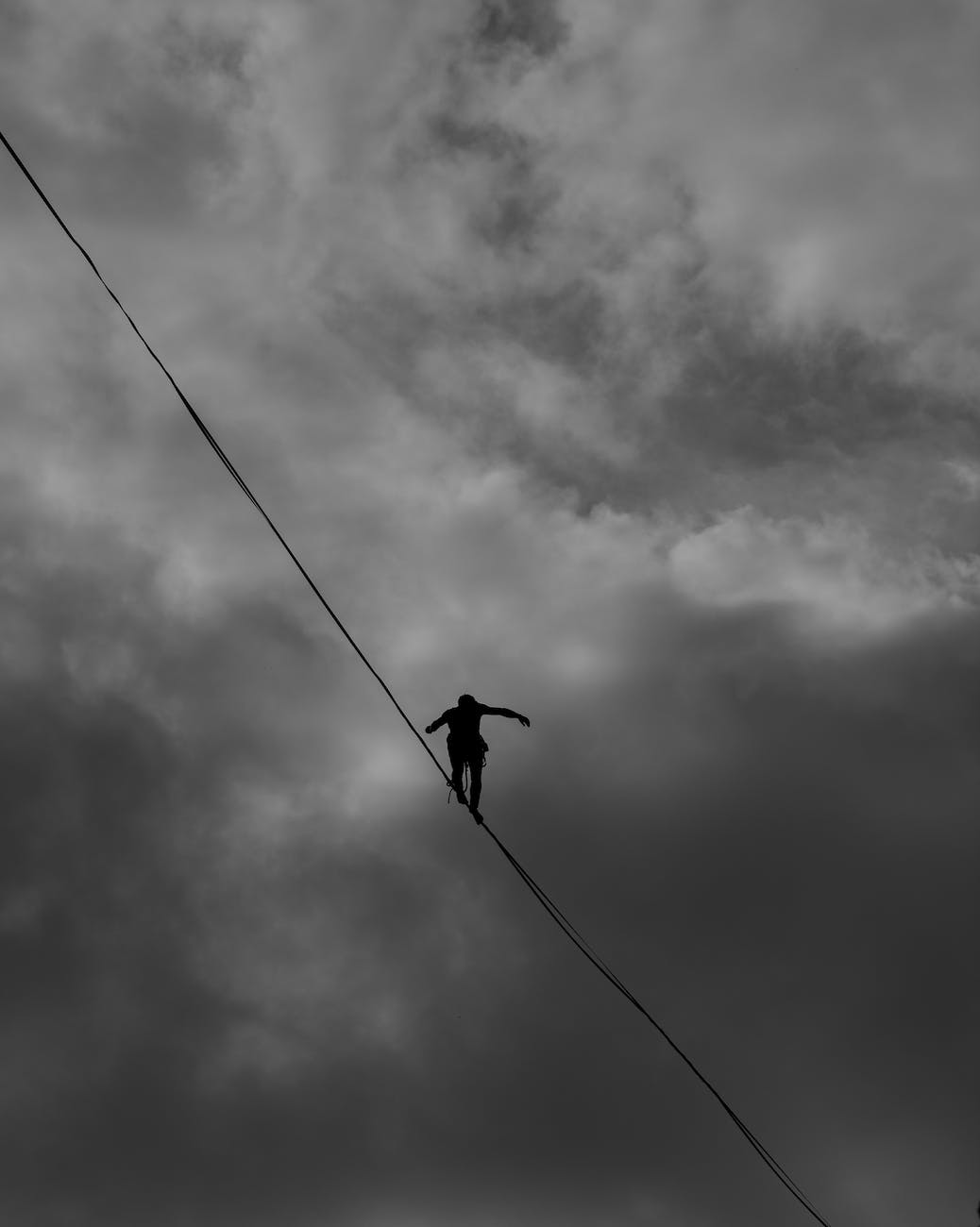
We reached the middle of the rope, farther than I thought we could make it. “How about two more steps?” I said. My partner agreed. And then, not because it was impossible to continue, but because I didn’t believe we could, because I didn’t want to fall, and because the harness and net and other pair of hands did nothing to convince me otherwise, we willingly let go, and all the tension and fear dissipated on the way down. It was a relief to let go of trying, knowing we would be safely lowered to the ground.
We were sheepish at the bottom and laughed it off as if it didn’t matter. But it nagged at me. Why did I let go of that tension so easily? Why didn’t I keep going and either reach this first goal or do everything I could to get there, risking an unplanned fall that would have been just as safe as the one we chose prematurely? Our teacher stressed that success comes only with 100% effort, and when you give only 90% you are doing almost as much work but not achieving your result. You are essentially giving up and only making it look like you did everything you could. Let’s just say that ropes course portended the rest of the 10-week class. My 90% effort did not get me to my goal.
2. Challenging Myself

Photo credit: Guy Shuman
With that shameful incident lodged somewhere in the back of my brain, I decided to give 100% on last fall’s challenging week of group road biking in the Solvang and Santa Barbara area. Jon and I had been invited to test ride the routes before they became official club rides this year. I never anticipated completing all five days of rides—after all, the full routes were mapped out for the advanced riders. Jon was advanced. I was intermediate. But what would happen, I wondered, if I kept riding and didn’t let go, if I tested my limits, if I did the hard thing?
Days 1 and 2 were manageable, nothing too crazy. Then came Day 3 when we started literally from sea level at Santa Barbara’s main beach, and climbed all the way to the top of Mount Gibraltar in the distance. It was very steep and dramatic looking back at the ocean far below where we had begun, and very challenging. After eating our sandwiches at the summit, I decided rather than turning back as planned, I would do the full route, continuing around the other side of the mountain with the few remaining members of our group (some had turned back and others had gone on ahead.) This required two more steep climbs before the equally steep descent all the way back down. It was about the hardest day of climbing I’d ever done, and I was elated at the end.
The next day was an equally difficult mountain climb up Mount Figueroa north of Los Olivos, and the conditions were worse — a three-mile section of road so rough it was pretty much all rough and no road, and then a huge climb in harsh gusting wind. Halfway through the ride I hit my limit, or in cycling terms, I bonked. But there was no easy way back to the start and no way an Uber could make it through. I needed about 40 minutes lying by the side of the road rehydrating and consuming electrolytes, amino acids, snacks, and energy blocks while being babysat by the ride leaders before I could even think of continuing the rest of the arduous climb. But I did it, even though I was almost blown off the road by a particularly forceful gust of wind. I completed that ride and the next day’s as well.
That week do the hard thing meant pushing my limits. I’d wanted to test my mettle and see how far I could go without “letting go of the rope.” By the end of the four and a half days I was exhausted, but ecstatic. I had made it through all five full routes: 200 miles and almost 20,000 vertical feet of climbing. I had done the hard thing.

Photo credit: Guy Shuman
3. Doing the Wrong Thing
Then came a recent misadventure on the Cazadero bike club weekend up in Occidental that made me rethink the meaning of the hard thing. And it involved a huge dog as big as a wolf.
On these club weekend trips, we do a warm-up ride on Friday, the big ride on Saturday, and an easier but still challenging “recovery” ride on Sunday. I’d done the Friday and Saturday rides the year before. Until those Solvang and Santa Barbara mountain climbs, Saturday’s ride was one of the hardest I’d ever done to that point. And also the most gorgeous with its zones of high ridge, cows, and cattle guards up King Ridge Road, through Redwood and other forests on Meyers Grade, steep ascents and descents so sharp at one point I couldn’t stop my bike. Then down to the ocean with long, looping curves back and forth, and rolling up and down to get to Jenner and Cafe Aquatica, before returning to our hotel in Occidental. I’d been looking forward to doing it again. This time it was pouring rain on Saturday morning and we delayed the start a bit. We still got rained on but then it cleared and was a beautiful day for riding. Just as challenging as the year before, but I forged ahead and felt energized, making sure to hydrate well and have regular snacks.
Then came Sunday’s “recovery ride” which I had missed the year before. Though the rest of the weekend had gone well, that morning I was not feeling great. Sometimes that happens at the beginning of a ride, and once I get warmed up I adjust. I’d pushed through in the past so I decided to go ahead with the planned route, though I could have skipped it or dropped down a level. As the miles went by, I started to feel light-headed, and then a little nauseous.
I had already fallen to the back of the pack when a steep hill appeared before me. In fact the other riders were already over the hill when I was starting up. I knew that after this, there was a downhill and then only a few more miles until the lunch break at a deli in town. But as I started up, a voice in my head said to stop. Mind over matter, I answered, overruling that other voice. Keep going. And I kept pushing the pedals around one slow circle at a time.
The other voice got louder, and I had to work harder to tune it out. Please stop, it begged. Please, please stop.
We all get those nagging voices in our heads, right? Usually mine was just being a little whiny. I’m tired, I’m hot, it’s hard to get going again, etc. But then it would work itself out. This time was different, and I knew it, but I willfully chose not to listen.
Cue the hell hound:

It was then that the huge black dog like a hound from hell loped into the road at the crest of the hill and stopped stock still like a sentinel. It stared straight down at me with its big saucer eyes.
“Turn back,” it said, its eyes boring into me. “This route is not for you.”
“What do you know?” I replied belligerently, “you’re just a dog.” And I forged ahead. By now the voice in my head was all but screaming in the background.
I can just push through I told myself. I’ve done it before. I was going so slow by then that my friend Mindy who was “the sweep” bringing up the tail finally had to pass me so she didn’t fall off her bike. Everyone else was long gone.
The dog began pacing back and forth.
Finally I reached the top. I was nervous what the dog was going to do, but at that point it gave up on me once and for all and vanished into a driveway. And instead of feeling the high that usually comes with flying down a hill after a big climb, I felt worse. The road was bumpy and potholed and I became even more nauseous and light-headed. When I finally reached the deli I was starving and had to beg food from friends until my sandwich was ready.
“Did you see that dog?” I asked them.
“What dog?”
The dog had appeared after they’d crested the hill. The dog had come for me.
I could have easily stayed at the picnic tables outside the deli and had Jon pick me up at the end of the ride. It was only 10 more miles back to the hotel. But I wanted to finish what I’d started, though even after all that food I still didn’t feel well.
The voice in the back of my head and the dog had gone silent, their pleas unheeded. I’d covered them over with a giant mute button.
It was a bad choice. Not listening to my own voice, or even the dog’s. The warnings were all there. In this instance Do the Hard Thing really meant stopping, as I had known deep inside it would someday. I just didn’t want to listen. I made it to the end of the ride, but not well.
That extra amount broke me. My mind and body were trying so hard to communicate that it was too much, but I intentionally tuned it all out. Just keep riding, keep climbing, don’t listen to those voices. Ride past them. Do the hard thing. Prove yourself. Bragging rights.
Brag to whom? Who cared?
In the final stretch, when I was struggling to not let the light-headedness and nausea overtake me, I asked Jon to stay close on his bike. I was excruciatingly slow by then, stopping every half mile or so for breaks. There weren’t many hills. The road was mostly flat or with a slight incline. I willed myself to keep going. I didn’t want to be a 90%’er.
So, I pushed through and “left everything on the road.” And I was depleted. I was broken. It felt less like a challenge or a recovery ride and more like a punishment or a test. The right answer on that test was not to push forward but to ease back.
The next day my back went out. Though I’ve had some back issues in the past, this was far worse than anything I’d ever experienced. It would be several weeks before I could even stand up from bed without stabbing pain, let alone get on my bike. I felt ill even thinking about riding again and was tired all the time. I had left it all on the road and there was nothing left.
4. Lessons Learned

So, then, what does it really mean to do the hard thing? It was time for some introspection and a reset. And because we’re talking about something hard, it took some time to figure this out.
First, there were some practical matters to take care of:
- I saw my doctor and was scheduled for a round of Physical Therapy sessions. I also got prescriptions for extra strength Ibuprofen and muscle relaxants to keep on hand in case something extreme happened again.
- I signed up for Pilates Reformer classes to strengthen my core and improve balance while I waited for the Physical Therapy to begin (which wasn’t until eight weeks later.)
- I replaced my running shoes and hiking boots, which I realized to my horror were in such bad shape that the soles were completely worn away, and I’m sure that contributed to my back going out.
- I made an appointment with my Naturopathic doctor whom I hadn’t seen in several years and was diagnosed with a Vitamin B12 deficiency. She prescribed a series of B-12 shots to boost my energy along with several other supplements.
- I began biking again. I’m still rebuilding my strength. It will take a while, but I’m glad to be back.
- And, I began this post. After several stabs at it and as many months trying to learn the answers to the questions “How do you know whether to push forward or ease back?” and “What is the hard thing, really?” I called up a few cycling friends for advice. And yeah, I knew by then that this question was probably about more than just biking….
Here is some of the wisdom I garnered:
- Listen to your gut.
- Know that you can push forward if necessary. Call upon that in an emergency, when there’s no other way out, or for a special challenge. That’s where having tested the limits comes in handy.
- You have to make some mistakes to learn your limits. (I was on track with that one!)
- Once you know your limits, you make rules:
- I.e. when Mindy was training for a triathlon, some of her rules were: Don’t run two days in a row. No hopping drills. Always stretch right after a run.
- Know how you feel and don’t be afraid to say you need a break.
- Use the data you have: not what you want to be true but how you actually feel to be conscious about your choices.
- And my biggest epiphany: Just because you CAN do something doesn’t mean you SHOULD do it!
- Last but not least: If a giant dog appears in your path with a warning, you should probably pay attention!!!
 Lisa Meltzer Penn
Lisa, you rock!
LikeLiked by 1 person
So glad you learned a valuable lesson, & won’t put yourself through that again
LikeLiked by 1 person
Hey Lisa, just curious…did you ever read Elizabeth Gilbert’s “Big Magic”??
I’m re-reading it and as I read it I often think of you on your creative journey!!
Maurine Killough
You are not IN the Universe you ARE the universe—an intrinsic part of it.
Ultimately you are not a person, but a focal point where the universe is becoming conscious of itself. What an amazing miracle.—Eckhart Tolle
Smilingeyestribe.com
Iwritemyself.worpress.com
LikeLiked by 1 person
Hey Maurine. I haven’t, but I will now! Thanks. Also I’ll be looking for a post from you as we seem to blog around the same time this year.
LikeLike
Lisa,
You have learned in a short time, but It took me over 50 years to learn in many sports.
Great job.
Tom Schnurbusch
LikeLiked by 1 person
At your service, Mr. Schurbusch!
LikeLike
Such a powerful experience. Thank you so much for sharing this, Lisa. I was totally engrossed and thinking about my own struggle to push my limits. Great advice.
LikeLiked by 1 person
Thank you so much, Geri! It’s such a complicated process, isn’t it? I drafted this four different ways as I worked to figure out what it was I needed to learn.
LikeLike
Well, to me, you did it right.
LikeLike
Thanks for writing about this experience and for sharing! Well done!
LikeLiked by 1 person
Well done on the writing. I know what you went through to write this and in that case, pushing through was the right thing. And sometimes the only way out is through; these were valuable lessons, and probably not ones you could have come by any other way.
LikeLiked by 1 person
Thanks Audrey! You’re a great writing buddy and I always appreciate the support. Also, well said.
LikeLike